Fong Appointed to Newsom Task Force

Heading 2

Lorem ipsum dolor sit amet, consectetur adipisicing elit. Nostrum minus ea suscipit porro alias corporis libero at. Perferendis omnis, veniam nemo beatae vel? Tempora numquam a repellat eaque natus, magnam?

Heading 2

Lorem ipsum dolor sit amet, consectetur adipisicing elit. Autem ipsum mollitia neque, illum illo excepturi, eum incidunt fugit nostrum est, voluptate eaque minima corporis debitis at, dolores ipsam. Quaerat, dolores.

Heading 2

Lorem ipsum dolor sit amet, consectetur adipisicing elit. Autem ipsum mollitia neque, illum illo excepturi, eum incidunt fugit nostrum est, voluptate eaque minima corporis debitis at, dolores ipsam. Quaerat, dolores.

Heading 2

Lorem ipsum dolor sit amet, consectetur adipisicing elit. Autem ipsum mollitia neque, illum illo excepturi, eum incidunt fugit nostrum est, voluptate eaque minima corporis debitis at, dolores ipsam. Quaerat, dolores.

Heading 2

Lorem ipsum dolor sit amet, consectetur adipisicing elit. Autem ipsum mollitia neque, illum illo excepturi, eum incidunt fugit nostrum est, voluptate eaque minima corporis debitis at, dolores ipsam. Quaerat, dolores.

Advisory group tasked to jump-start state’s economy

SACRAMENTO, CA (April 17, 2020) – California Governor Gavin Newsom today appointed California Grocers Association President and CEO Ron Fong to serve on his bi-partisan Task Force on Business and Jobs Recovery, responsible with helping plan the state’s economic recovery following the financial calamity resulting from COVID-19.

“I am extremely honored to participate on this very impressive and diverse task force that gives the grocery industry a seat at the table as we work to get our state economy up and running again,” Fong said. California’s grocery industry is one of the state’s largest employers, employing more than 350,000 Californians.

“I look forward to collaborating with thought leaders from throughout California as we develop recommendations for both government and business to help revive our economy and guide the state back toward economic growth and recovery,” he added.

The 80-member task force is co-chaired by former U.S. presidential candidate and billionaire philanthropist Tom Steyer and Gov. Newsom’s Chief of Staff Ann O’Leary, and includes representatives from business, labor, environment, social justice, state legislature and four former California governors.

“This is a tremendous honor for our industry to be represented on this task force,” said CGA chair Phil Miller, C&S Wholesale Grocers. “This pandemic has hit families and businesses in ways none of us could have ever imagined. Ron is uniquely positioned to add a valuable perspective as he represents California’s grocery Industry which sits squarely on the front lines of helping keep families feed and energized as we collectively navigate through this crisis.”

Task Force on Business and Jobs Recovery Advisory Members

Gov. Newsom Press Release: Task Force on Business and Jobs Recovery

Garcetti Touts Industry Efforts to Limit Overbuying

Heading 2

Lorem ipsum dolor sit amet, consectetur adipisicing elit. Nostrum minus ea suscipit porro alias corporis libero at. Perferendis omnis, veniam nemo beatae vel? Tempora numquam a repellat eaque natus, magnam?

Heading 2

Lorem ipsum dolor sit amet, consectetur adipisicing elit. Autem ipsum mollitia neque, illum illo excepturi, eum incidunt fugit nostrum est, voluptate eaque minima corporis debitis at, dolores ipsam. Quaerat, dolores.

Heading 2

Lorem ipsum dolor sit amet, consectetur adipisicing elit. Autem ipsum mollitia neque, illum illo excepturi, eum incidunt fugit nostrum est, voluptate eaque minima corporis debitis at, dolores ipsam. Quaerat, dolores.

Heading 2

Lorem ipsum dolor sit amet, consectetur adipisicing elit. Autem ipsum mollitia neque, illum illo excepturi, eum incidunt fugit nostrum est, voluptate eaque minima corporis debitis at, dolores ipsam. Quaerat, dolores.

Heading 2

Lorem ipsum dolor sit amet, consectetur adipisicing elit. Autem ipsum mollitia neque, illum illo excepturi, eum incidunt fugit nostrum est, voluptate eaque minima corporis debitis at, dolores ipsam. Quaerat, dolores.

COVID-19: How Grocers Are Meeting the Challenge

Heading 2

Lorem ipsum dolor sit amet, consectetur adipisicing elit. Nostrum minus ea suscipit porro alias corporis libero at. Perferendis omnis, veniam nemo beatae vel? Tempora numquam a repellat eaque natus, magnam?

Heading 2

Lorem ipsum dolor sit amet, consectetur adipisicing elit. Autem ipsum mollitia neque, illum illo excepturi, eum incidunt fugit nostrum est, voluptate eaque minima corporis debitis at, dolores ipsam. Quaerat, dolores.

Heading 2

Lorem ipsum dolor sit amet, consectetur adipisicing elit. Autem ipsum mollitia neque, illum illo excepturi, eum incidunt fugit nostrum est, voluptate eaque minima corporis debitis at, dolores ipsam. Quaerat, dolores.

Heading 2

Lorem ipsum dolor sit amet, consectetur adipisicing elit. Autem ipsum mollitia neque, illum illo excepturi, eum incidunt fugit nostrum est, voluptate eaque minima corporis debitis at, dolores ipsam. Quaerat, dolores.

Heading 2

Lorem ipsum dolor sit amet, consectetur adipisicing elit. Autem ipsum mollitia neque, illum illo excepturi, eum incidunt fugit nostrum est, voluptate eaque minima corporis debitis at, dolores ipsam. Quaerat, dolores.

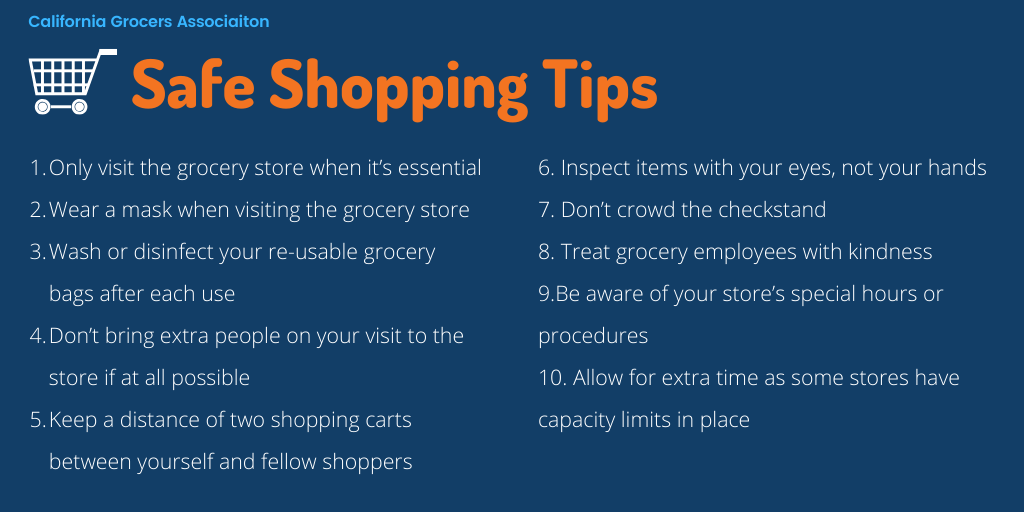
10 Safe Shopping Tips

With daily news outlets reporting alarming increases throughout California in the number of COVID-19 related cases, the California Grocers Association (CGA) is urging Californians to remain vigilant in practicing safe shopping protocols.

Here are a few tips to help ensure a safe shopping experience for everyone:

1. Only visit the grocery store when it’s essential. Be creative with what you already have at home before going to the store.

2.  Wear a mask when visiting the grocery store, by doing so, you’ll be doing your part to keep your fellow shoppers and grocery store employees healthy.

3. Wash or disinfect your re-usable grocery bags after each use. Some grocery stores are not accepting re-usable bags in order to comply with city or county COVID-19 health orders.

4. Help reduce store crowding. Don’t bring extra people on your visit to the store if at all possible.

5. Practice social distancing within the store. The CDC guideline is to maintain six feet, or two grocery carts, between yourself and other shoppers.

6. Inspect items with your eyes, not your hands. To avoid unnecessary handling of fruits and vegetables use a produce bag to make your selection.

7. Don’t crowd the checkstand. As a courtesy, some grocers have marked the floors in and around the store to help you keep a healthy distance from your fellow shoppers.

8. Treat grocery employees with kindness. They are working hard to provide everyone with safe access to the food and supplies they need. Be patient as they go about their work including additional cleaning protocols and consider acknowledging them with a big “thank you”.

9. Be aware of your store’s special hours or procedures. Many grocers are offering special shopping hours exclusively for seniors or other vulnerable populations. Check out your store’s website or call in advance.

10. Allow for extra time. Some stores are queuing customers outside their main entrance to reduce crowding within the store.

We are all in this together #Enough4All


Grocery Stores Enhance Commitment to Health & Safety for Employees & Customers


California Grocers Association Urges Restraint When Grocery Shopping

Every Visit Has a Story

Heading 2

Lorem ipsum dolor sit amet, consectetur adipisicing elit. Nostrum minus ea suscipit porro alias corporis libero at. Perferendis omnis, veniam nemo beatae vel? Tempora numquam a repellat eaque natus, magnam?

Heading 2

Lorem ipsum dolor sit amet, consectetur adipisicing elit. Autem ipsum mollitia neque, illum illo excepturi, eum incidunt fugit nostrum est, voluptate eaque minima corporis debitis at, dolores ipsam. Quaerat, dolores.

Heading 2

Lorem ipsum dolor sit amet, consectetur adipisicing elit. Autem ipsum mollitia neque, illum illo excepturi, eum incidunt fugit nostrum est, voluptate eaque minima corporis debitis at, dolores ipsam. Quaerat, dolores.

Heading 2

Lorem ipsum dolor sit amet, consectetur adipisicing elit. Autem ipsum mollitia neque, illum illo excepturi, eum incidunt fugit nostrum est, voluptate eaque minima corporis debitis at, dolores ipsam. Quaerat, dolores.

Heading 2

Lorem ipsum dolor sit amet, consectetur adipisicing elit. Autem ipsum mollitia neque, illum illo excepturi, eum incidunt fugit nostrum est, voluptate eaque minima corporis debitis at, dolores ipsam. Quaerat, dolores.

How Northgate became one of L.A.’s best Mexican supermarkets

As part of celebrating Northgate’s 40th anniversary, the Los Angeles Times wrote a glowing review of the business the Hispanic grocer has built in Southern California, saying:

“During its 40 years in business, Northgate has established itself as, arguably, the best Mexican supermarket in town. But at the start of a new decade, the family-run company finds itself catering to a large and increasingly diverse customer base across Southern California.”

Industry: Coronavirus Updates

Heading 2

Lorem ipsum dolor sit amet, consectetur adipisicing elit. Nostrum minus ea suscipit porro alias corporis libero at. Perferendis omnis, veniam nemo beatae vel? Tempora numquam a repellat eaque natus, magnam?

Heading 2

Lorem ipsum dolor sit amet, consectetur adipisicing elit. Autem ipsum mollitia neque, illum illo excepturi, eum incidunt fugit nostrum est, voluptate eaque minima corporis debitis at, dolores ipsam. Quaerat, dolores.

Heading 2

Lorem ipsum dolor sit amet, consectetur adipisicing elit. Autem ipsum mollitia neque, illum illo excepturi, eum incidunt fugit nostrum est, voluptate eaque minima corporis debitis at, dolores ipsam. Quaerat, dolores.

Heading 2

Lorem ipsum dolor sit amet, consectetur adipisicing elit. Autem ipsum mollitia neque, illum illo excepturi, eum incidunt fugit nostrum est, voluptate eaque minima corporis debitis at, dolores ipsam. Quaerat, dolores.

Heading 2

Lorem ipsum dolor sit amet, consectetur adipisicing elit. Autem ipsum mollitia neque, illum illo excepturi, eum incidunt fugit nostrum est, voluptate eaque minima corporis debitis at, dolores ipsam. Quaerat, dolores.

Public Statements

CGA Statement on Grocery Industry Conditions


Statewide Announcements

As Gov. Gavin Newsom and state health and emergency response officials respond to the COVID-19 pandemic, we’re compiling the most important announcements of new guidances and directives for you.


Local Government Updates

The state’s response to the coronavirus update is following a “local up” approach, where county and city governments drive strategies and tactics for their own communities. New ordinances and directives are rapidly-changing, and CGA is tracking these new developments as they occur.


Resources

Navigating uncharted waters requires additional support, which is why CGA is curating the best resources available to help you successfully respond to the COVID-19 challenge.


Need additional information? Contact Dave Heylen at 916-448-3545 or by email.

Consumer Privacy Webinar

Heading 2

Lorem ipsum dolor sit amet, consectetur adipisicing elit. Nostrum minus ea suscipit porro alias corporis libero at. Perferendis omnis, veniam nemo beatae vel? Tempora numquam a repellat eaque natus, magnam?

Heading 2

Lorem ipsum dolor sit amet, consectetur adipisicing elit. Autem ipsum mollitia neque, illum illo excepturi, eum incidunt fugit nostrum est, voluptate eaque minima corporis debitis at, dolores ipsam. Quaerat, dolores.

Heading 2

Lorem ipsum dolor sit amet, consectetur adipisicing elit. Autem ipsum mollitia neque, illum illo excepturi, eum incidunt fugit nostrum est, voluptate eaque minima corporis debitis at, dolores ipsam. Quaerat, dolores.

Heading 2

Lorem ipsum dolor sit amet, consectetur adipisicing elit. Autem ipsum mollitia neque, illum illo excepturi, eum incidunt fugit nostrum est, voluptate eaque minima corporis debitis at, dolores ipsam. Quaerat, dolores.

Heading 2

Lorem ipsum dolor sit amet, consectetur adipisicing elit. Autem ipsum mollitia neque, illum illo excepturi, eum incidunt fugit nostrum est, voluptate eaque minima corporis debitis at, dolores ipsam. Quaerat, dolores.

Complying with California’s Consumer Privacy Act

Jan. 1, 2020 marked the beginning of a new era in consumer protection as the California Consumer Privacy Act (CCPA) took effect. The CCPA has brought sweeping changes to how companies are allowed to market and store data, in addition to many compliance challenges.

To help our members meet this challenge, we’ve enlisted attorney Peter Stockburger from the law firm Dentons LLP to take us through a deep dive of the new law.

This webinar took place Wednesday, Feb. 19, 2020, but is now available to view for those of you who may have missed this session.

The California State Legislature Returns

Heading 2

Lorem ipsum dolor sit amet, consectetur adipisicing elit. Nostrum minus ea suscipit porro alias corporis libero at. Perferendis omnis, veniam nemo beatae vel? Tempora numquam a repellat eaque natus, magnam?

Heading 2

Lorem ipsum dolor sit amet, consectetur adipisicing elit. Autem ipsum mollitia neque, illum illo excepturi, eum incidunt fugit nostrum est, voluptate eaque minima corporis debitis at, dolores ipsam. Quaerat, dolores.

Heading 2

Lorem ipsum dolor sit amet, consectetur adipisicing elit. Autem ipsum mollitia neque, illum illo excepturi, eum incidunt fugit nostrum est, voluptate eaque minima corporis debitis at, dolores ipsam. Quaerat, dolores.

Heading 2

Lorem ipsum dolor sit amet, consectetur adipisicing elit. Autem ipsum mollitia neque, illum illo excepturi, eum incidunt fugit nostrum est, voluptate eaque minima corporis debitis at, dolores ipsam. Quaerat, dolores.

Heading 2

Lorem ipsum dolor sit amet, consectetur adipisicing elit. Autem ipsum mollitia neque, illum illo excepturi, eum incidunt fugit nostrum est, voluptate eaque minima corporis debitis at, dolores ipsam. Quaerat, dolores.

This week the state legislature returned to Sacramento for the second half of itsr two-year session. This means CGA will again enter in the daily grind of influencing policy and legislation on behalf of the industry. The second year of a session is always a little more interesting — and complicated — and 2020 will likely not disappoint.

As legislators reconvene, they will be dealing with leftover legislation introduced last year. They also have an opportunity to introduce new legislation. Topping the issues list are disaster resiliency and power shut-offs, addressing housing challenges, and a possible second look at independent contractor regulations. For the grocery industry, addressing CRV recycling issues and pushing for a statewide packaging-solution will top the list.

The upcoming election is also sure to be a major influence on the second half of this legislative session. California’s primary election is earlier than usual, and the November General Election means elected officials will filter many (read all) of their decisions through the polling perspective. Some years, pending elections result in a cautious, muted approach to governing while others stir up bold, progressive action.

Whatever the political course or policy issue thrown at grocers this year, it is up to us to decide our fate. We look forward to representing the industry forcefully and diligently, but we can’t do it alone. Your knowledge, counsel, and participation is needed to steer a clear route through the dangers. Please consider joining the CGA Government Relations Committee to stay informed and weigh-in to benefit your company and the industry. Contact CGA’s Government Relations Department to join in or learn more.

Six of Our Favorite 2019 California Grocer Articles

Heading 2

Lorem ipsum dolor sit amet, consectetur adipisicing elit. Nostrum minus ea suscipit porro alias corporis libero at. Perferendis omnis, veniam nemo beatae vel? Tempora numquam a repellat eaque natus, magnam?

Heading 2

Lorem ipsum dolor sit amet, consectetur adipisicing elit. Autem ipsum mollitia neque, illum illo excepturi, eum incidunt fugit nostrum est, voluptate eaque minima corporis debitis at, dolores ipsam. Quaerat, dolores.

Heading 2

Lorem ipsum dolor sit amet, consectetur adipisicing elit. Autem ipsum mollitia neque, illum illo excepturi, eum incidunt fugit nostrum est, voluptate eaque minima corporis debitis at, dolores ipsam. Quaerat, dolores.

Heading 2

Lorem ipsum dolor sit amet, consectetur adipisicing elit. Autem ipsum mollitia neque, illum illo excepturi, eum incidunt fugit nostrum est, voluptate eaque minima corporis debitis at, dolores ipsam. Quaerat, dolores.

Heading 2

Lorem ipsum dolor sit amet, consectetur adipisicing elit. Autem ipsum mollitia neque, illum illo excepturi, eum incidunt fugit nostrum est, voluptate eaque minima corporis debitis at, dolores ipsam. Quaerat, dolores.

From our “Mommy Blogger-in-Residence” to Kevin Coupe’s running column, 2019 was another great year of California Grocer content. Below are just six of our favorites, but you can browse every article from 2019 in our magazine archive.

  1. In “Navigating Today’s Incredible Pace of Change” Past Board Chair Kendra Doyel details the strengths of California’s grocery community ahead of another year filled with industry-wide disruption.
  2. 2019 saw the opening of the new CGA Headquarters in downtown Sacramento. If you haven’t yet seen this beautiful building, you won’t want to skip this magazine feature.
  3. This past year we also got our first taste of life under a new governor. Writing “Newsom’s First Nine Months,” CGA CEO Ron Fong explores the first portion of the 2019-20 legislative session.
  4. As large retailers continue to disrupt themselves at lightning speed, the onus is on independent grocers to match their pace. Featuring former Grocery Dive writer, Jessica Dumont, our “How Independent Grocers Can Finish First in 2019″ deep dive explains how smaller retailers can adapt to this new landscape.
  5. The state’s recycling struggles and a growing concern about climate change has caused food and drink packaging to dominate the past few years of grocery-related policy debate and is likely to continue into the 2020s. Read “Balancing Food Packaging and the Environment” for the full cost-benefit analysis.
  6. Rounding out the top six is our write-up on this year’s “Legend of the Industry” scholarship recipient and his truly amazing path into California’s grocery community.

It’s All About the Experience

Heading 2

Lorem ipsum dolor sit amet, consectetur adipisicing elit. Nostrum minus ea suscipit porro alias corporis libero at. Perferendis omnis, veniam nemo beatae vel? Tempora numquam a repellat eaque natus, magnam?

Heading 2

Lorem ipsum dolor sit amet, consectetur adipisicing elit. Autem ipsum mollitia neque, illum illo excepturi, eum incidunt fugit nostrum est, voluptate eaque minima corporis debitis at, dolores ipsam. Quaerat, dolores.

Heading 2

Lorem ipsum dolor sit amet, consectetur adipisicing elit. Autem ipsum mollitia neque, illum illo excepturi, eum incidunt fugit nostrum est, voluptate eaque minima corporis debitis at, dolores ipsam. Quaerat, dolores.

Heading 2

Lorem ipsum dolor sit amet, consectetur adipisicing elit. Autem ipsum mollitia neque, illum illo excepturi, eum incidunt fugit nostrum est, voluptate eaque minima corporis debitis at, dolores ipsam. Quaerat, dolores.

Heading 2

Lorem ipsum dolor sit amet, consectetur adipisicing elit. Autem ipsum mollitia neque, illum illo excepturi, eum incidunt fugit nostrum est, voluptate eaque minima corporis debitis at, dolores ipsam. Quaerat, dolores.

After decades in and around the food business, Phil Miller has come to one indisputable conclusion – the customer experience is much more important than having the most unique products at the best price.

“In the past, retailers and wholesalers could steer people towards items they wanted them to purchase,” said Miller, Vice President of Sales, Western Region for C&S Wholesale Grocers, and incoming Chair of the CGA Board of Directors. 

“With technology where it is, new emerging markets for home delivery and easy access to products from all over the world, the industry has to be more creative and diverse in its product offerings and change them more frequently to stay ahead of the consumer demand curve,” Miller said. “To me, that’s the biggest dynamic impacting the business.”

Miller, who grew up around the business, has had a bird’s eye view of the changes the industry has gone through. His maternal grandfather was a butcher by trade who managed an independent grocery store in Pine Bluff, Ark. His paternal grandfather was a farmer who owned and operated a local market store on his property in Cotton Plant, Ark., a small rural town about halfway between Memphis, Tenn., and Little Rock, Ark.

However, Miller’s journey didn’t start in the food industry. 

His father was a physician and partner in the state’s first integrated medical practice, and his mother was an educator and passionate pioneer in community service for decades in the central Arkansas community. 

“My family placed a high priority on education and encouraged me to gain exposure in a variety of areas but to ultimately follow my passion, dedication and God-given talents of working with people, stating, no matter what you decide to do, be the best at whatever it is,” he said.

After exploring the thought of studying to become a dentist, he landed on the discipline of finance. He graduated from Kennesaw State University in Georgia with a degree in finance and spent several years working at United Parcel Service as well as in the financial industry with a local Atlanta investment firm. 

He got into food retail with the national retail yogurt chain TCBY and relocated to New York, where he eventually became District Manager of Franchise Operations for the Northeast Region. 

In 1997, Miller joined the Refreshment Services Division of Aramark as General Manager in Allentown, Pa., quickly being promoted to similar roles with increasing responsibility in Boston in 1998 and back to New York City in 2000 before relocating to the West Coast in 2007 as District Manager of the Western Region. 

In 2009, he accepted his current role with C&S Wholesale Grocers, reconnecting him to his family industry roots growing up in Arkansas.

Assessing the grocery industry today, and California in particular, Miller noted that it’s easy to pinpoint competition, including e-commerce as the driving force or disrupter in the business. 

“But,” he adds, “To me, it’s all about having a unique brand and competing for customer loyalty with customization, convenience, and providing your customer with a memorable shopping experience.”

According to Miller, these are the portals that change constantly depending on your customer base.

“Everyone these days has to remain nimble enough to make changes that attract new customers as well as keep current customers loyal and interested in the shopping experience you offer,” he shared.

“Our business environment is changing so rapidly that we have to adapt constantly,” he added. “Sometimes, we can get used to doing things a certain way, but there’s always the need for creativity not only in how we take care of customers but also our employees.”

Miller says that with today’s record-low unemployment rate, hiring and retaining a talented workforce is one of the industry’s biggest challenges. 

“I think the industry as a whole is experiencing a shortfall in attracting motivated talent willing and ready to work certain positions, especially on the warehouse and transportation side,” he said, adding that the solution won’t be an easy one.

“It has to revolve around training and development,” he recommends. “We have to focus on ways to attract, develop and train young people in a way that offers them a personalized career path that will allow them to eventually realize a vision of how to work hard, navigate and eventually move up in our organizations.”

Looking ahead, Miller’s focus remains on people in the industry – especially independent retail owners who may be looking at retirement or getting out of the business outright. 

“We service several chains throughout our C&S network, but the heart and soul of our customer base are our independents, so I am always looking at issues from an independent’s perspective,” he said. 

“With all the consolidation in the market, the population of aging owners is a concern. When we get down to the third or fourth generation operators, we don’t often see the same level of passion for running the business. 

“This makes succession planning an essential issue for the years ahead. We have to ensure that we maintain a diverse independent grocery population that won’t disappear,” he said.

However, changing demographics must also remain a top priority for the industry, said Miller. 

“Some retailers started out supplying a consumer base that might have been 80 percent Anglo and never took an inventory of the changing demographics in their marketing areas and never changed the product mix,” he shared. 

“You can no longer assume that populations will remain the same forever. Grocers must make constant use of data analytics to understand the large and small changes in their target market area and make changes to their product portfolios and service options to stay viable. If not, many will one day find themselves behind the eight ball,” said Miller, noting that demographic changes that once took place over a five to 10-year period can now occur at a much faster pace.

This plays into the e-commerce piece of the business. 

“If I’m in rural California and the majority of my consumers are first and second-generation members of their respective ethnicity, it’s easy to assume there’s no interest in online shopping or grocery delivery options and therefore no urgent need to get into that business,” Miller said.

“That is a fallacy that every independent grocer has to get over,” he adds. “Look at the market for cell phones. In 2007, Apple introduced the iPhone, and now they’re up to version 11. Technology and consumer demand are moving ahead so rapidly that all retailers have to get into the game sooner rather than later.”

This brings up the issue of keeping up with retail technology. 

“I know the first thing to happen is sticker shock, and it can be difficult in some cases for retailers to see the return on investment,” Miller said. “But, I believe there’s a growing population of grocers that have the benefit of employing a younger generation who understands the value of technology from a consumer’s perspective and can have a lot of influence in helping others understand the importance and urgency of implementation of e-commerce platforms.”

The theme of this year’s CGA Strategic Conference was Minding the Gaps and provided a perfect opportunity to help advance the industry, according to Miller. 

“We’ve got to find a way to bridge that generational technology gap. It is perfectly okay to cherish the past, but only to use those principles as a solid base for moving forward and holding hands with the future,” he said.

Miller believes technology will be a priority this year and wants to take the learning’s from the conference to develop a platform for CGA moving into 2020 – one that connects the dots and continues to bridge the gap for retailers. 

“We want to give them (retailers) the tools to enhance their ability to serve their shoppers for years to come,” he added.

Turning to CGA, Miller said the association’s staff is “an amazing team who are unique in terms of their passion for and knowledge of the industry.” 

This is the strength that helps the association build productive relationships throughout California, whether it’s at the statehouse in Sacramento, or working with single store operators throughout the state, Miller said, adding, “They do an incredible job of staying connected and understanding what the pain points are for all retailers and advocating on their behalf.”

“CGA is all about encouraging innovation, not just from a technology perspective, but altering, reshaping, or completely redesigning ways to educate members about the issues affecting their business,” he said.

At the same time, all members need to be actively involved in the association, according to Miller. 

“Part of our challenge is showing the independent operators the value and return on investment for being part of CGA,” he said. “That doesn’t fall completely on CGA’s leadership but also on companies like C&S that work with retailers every day.” 

CGA President and CEO Ron Fong has tremendous praise for his incoming Chair.

“I have known Phil for some time, and his enthusiasm and love of this industry are evident in everything he does,” Fong said. “His ability to communicate, build relationships, coupled with his considerable knowledge, makes him the perfect chair during this very volatile and transitional period in our industry. I look forward to working closely with him this coming year.”

The C&S executive will take the reins of CGA in early December and serve for one year. During that time, Miller will help guide the Association’s Board of Directors, and participate in numerous leadership opportunities, including meeting with local, state, and national elected officials, as well presenting at various CGA and other industry-related events.

Asked about his personal agenda for the coming year, Miller replied: “I’m big on education and awareness, and believe we are stronger because of our association’s diversity. 

“I want to continue building an association that is respected not only in California but across the country,” he said. “I think we’re looking at a window of opportunity to do some special things in the coming year.”

Rethinking the Form and Shape of Grocery Stores

Heading 2

Lorem ipsum dolor sit amet, consectetur adipisicing elit. Nostrum minus ea suscipit porro alias corporis libero at. Perferendis omnis, veniam nemo beatae vel? Tempora numquam a repellat eaque natus, magnam?

Heading 2

Lorem ipsum dolor sit amet, consectetur adipisicing elit. Autem ipsum mollitia neque, illum illo excepturi, eum incidunt fugit nostrum est, voluptate eaque minima corporis debitis at, dolores ipsam. Quaerat, dolores.

Heading 2

Lorem ipsum dolor sit amet, consectetur adipisicing elit. Autem ipsum mollitia neque, illum illo excepturi, eum incidunt fugit nostrum est, voluptate eaque minima corporis debitis at, dolores ipsam. Quaerat, dolores.

Heading 2

Lorem ipsum dolor sit amet, consectetur adipisicing elit. Autem ipsum mollitia neque, illum illo excepturi, eum incidunt fugit nostrum est, voluptate eaque minima corporis debitis at, dolores ipsam. Quaerat, dolores.

Heading 2

Lorem ipsum dolor sit amet, consectetur adipisicing elit. Autem ipsum mollitia neque, illum illo excepturi, eum incidunt fugit nostrum est, voluptate eaque minima corporis debitis at, dolores ipsam. Quaerat, dolores.

“So what can I do with that?” 

This is a basic question we ask ourselves every day, everywhere we go and with just about everything we encounter in our daily life. This is not an out loud question, but something that happens under our level of consciousness, as a natural part of our brain’s automatic processing system. 

This processing starts first with our senses, which serve as a complex network of receptors and pathways that communicate pertinent information to our brain. Like a reconnaissance team, our eyes and other senses are constantly scanning our environment to gather relevant information and then make all kinds of snap decisions on behalf of our brain, which serves as the mission control center. 

What is the brain’s recon team looking for? 

Well, on a very primal level, it is looking for two critical things: enhancements or impediments to life. 

Our brain and senses are constantly on the lookout for things that can help make our life better, happier, easier, more pleasurable, etc.—and to avoid things that can harm us, frustrate us, slow us down or get in the way of our intentions. 

As we go about our daily activities, our subconscious brain is continuously trying to make sense of the world around us by detecting, decoding and determining what it sees, hears, feels, tastes and smells. But this sense-making ability requires lots of energy, most of which is fueled by a form of sugar called glucose. 

Because the brain is so rich in nerve cells, or neurons, it is the most energy-demanding organ we have, using one-half of all the sugar energy in the body. To resolve this problem of limited brainpower, our more efficient subconscious system takes over the bulk of our decision-making. This subconscious system works in the background and conserves energy by doing something called predictive coding

In short, predictive coding is an automatic process our brain uses to quickly scan our environment and make microsecond decisions about what something is, whether that something can help or hurt us and, most importantly, trying to answer the question of what can we do with that something. We rely on this predictive coding mechanism because it reduces our need to study everything around us in exhausting detail. 

Instead, our background thinking just quickly assesses the “form and shape” of things in front of us for recognition and match for something we already know, but there are times when we don’t know what something is, which triggers and alerts are more conscious brain to get involved. 

A Caveman Walks into a Cooking Store

The first time I saw a mandoline—not the musical instrument, but that kitchen contraption to julienne vegetables— I was in a fancy cooking accessory stores. I didn’t know what a mandoline was for, what I could do with it or how it could possibly help my life in any way. There wasn’t anyone in the store available to help me, so my caveman-brain tried to figure it out on its own. After a few seconds of trying to solve the complex riddle of “what does this weird-looking thing do?” my caveman brain simply gave up and I moved on to the next thing: a shiny new gas grill! My caveman brain knew exactly what I could do with this thing! 

It took me many years and lots of cut fingers to finally see a mandoline being used on a cooking show. The celebrity chef revealed it to be one of the most valuable kitchen tools he had. In that moment of watching him slice and dice vegetables so effortlessly and so beautifully, I couldn’t help but involuntarily declare: 

Aha! I get it! Time to buy a mandoline! 

This moment, when consumers finally “get it,” is a pivotal turning point for understanding consumer behavior. But it is not only consumers that ask this basic question: “What I can do with that?” Inventors, scientists and entrepreneurs also like to ponder and experiment with this question, but in a much more conscious and deliberate way. 

Love at First Sight 

I remember when I heard Steve Jobs was developing a cell phone. It was the summer of 2007 and I just didn’t get it. Since its inception, I have always been a dyed-in-the-wool Apple fanatic, but even I dared question the prophecy according to Jobs with the query: “Why in the world would I buy a cell phone from Steve Jobs?” 

Now technically, the iPhone was a “smart phone,” but based on its form and shape, it looked a lot like a glorified cell phone to me. Besides I was kind of dumb to what a smart phone even was back then. 

I read several articles about the upcoming iPhone unveiling, which included an exposition of seductively revealing photographs that showcased this supposedly leading edge product. I studied those photos closely but, just like the mandoline, my brain still couldn’t figure out what on earth I would do with it. 

My life was already technologically challenging enough with devices, so I pretty much resolved myself to the idea that— despite my intense love, admiration and loyalty to Apple—I wouldn’t be buying the new iPhone anytime soon. 

Or so I thought… 

Ironically enough, on the day the new iPhone came out, I just happened to be in a shopping center with a new Apple Store, so I walked in. And there it was, lying naked on the table: the gloriously designed new iPhone. One of the young Apple employees with a cool-looking t-shirt and lanyard walked up to me and said: “You want to try it?” I hesitated for a bit, and then said, “Ehhh…Sure! Why not?” 

At this point in time, I had a fashionable Motorola Razr flip phone in my back pocket that I would often try to inconspicuously show off to others. I got that Razr phone for nearly free from my carrier (with a long-term contract). I couldn’t imagine parting with it anytime soon, particularly since the new iPhone 8G model was a whopping $599. 

I remember thinking to myself, “What idiot would pay that much for a cell phone they could get for free?”— particularly from a company without experience in the cell phones. But as soon as I placed that new iPhone in my hand and felt the edges, the profound simplicity of the navigational touch features and the iconic array of apps on the screen, my senses and brain immediately said to me in unison: 

Wow! I think I can do a lot with this! 

Sold! 

There was no more explanation needed. It was that instantaneous of a decision. 

I bought the new iPhone on the spot. Although I was now $599 poorer, I was filthy rich with excitement, anticipation and newfound pride for what I could do with this new, never-seen-before object. 

From Painters Van to Family Transportation Solution 

If you go back through the history of business innovation, you can find these very distinct moments where an unidentified foreign object is placed into our hands, or in front of us as something to inhabit or experience. The moments have the potential to open our minds up to a variety of new, previously unimaginable possibilities. 

Such was the case for Plymouth Voyager. 

Back in the early 1980s, Lee Iacocca, the former chairman and CEO of Chrysler, got us to rethink what we could do with the existing form and shape of the van by creating what he called a “mini-van.” 

Prior to Iacocca’s introduction of the minivan, the only people that had vans were construction workers, painters and a few hippies that converted their utility vans, at great expense, into shag carpeted mobile bachelor pads. But my mom wouldn’t be caught dead riding around in a “painter’s van” or a “bachelor pad van,” particularly with her innocent kids in tow. 

The mere prospect that my mom would buy, much less drive a minivan around the neighborhood was totally unimaginable at the time, which may be why Henry Ford II laughed at the idea and dismissed Iacocca’s first initial sketches of the minivan concept while he was at Ford. So too did the focus groups. 

Iacocca was eventually fired from Ford for other reasons and moved on to head up Chrysler (Plymouth and Dodge). He was allowed to take the minivan idea and designs with him. But like Steve Jobs, Lee Iacocca had a new vision for what we could do with the painter’s van that few people got. He saw it as the new station wagon, the new family-oriented transportation solution and the next big wave of the future in automobile innovation. 

And he was right. 

After some major adjustments and the addition of wood side paneling, families immediately embraced this new form and shape, and the minivan went on to become one of the biggest selling phenomenons in automotive history. And once moms everywhere saw it in person, they immediately knew what they could do with that thing.

Gelsons Manhattan Beach. Manhattan Beach, CA. Shook Kelley Architects.

The Predictable Forms and Shapes of the Retail World 

Most of us know what a convenience store, gas station, drugstore, coffee shop and grocery store look like simply by looking at the form and shape of the buildings. These standard building typologies represent a very predictable form and shape in our world and therefore our conscious brain doesn’t need to pay too much attention to them as we go about our day. 

When we see a building that looks like a gas station/convenience store on the corner of an intersection, we don’t have to think too much about what we can do there. 

Our brains have been conditioned to know that we can fill up our car with gas, and run in to grab a soda, beer and/or a pack of smokes. However, we typically don’t expect to get handmade sushi, fresh organic vegetables or the best cuts of meat inside a gas station/convenience store, even though consumers would like to find these kinds of products in a small, format store. That idea is incongruous to what we think gas stations/convenience stores can do for us. 

This fundamental assumption by consumers is part of the reason why gas station/convenience stores have such a hard time moving beyond just selling gas, sodas, beer and cigarettes. And this inability to shift the consumer’s mind to other product categories has executives at convenience stores nervous. 

Why? 

Because many in the industry believe these top selling items are all under threat by social activists, concerned parents and the government, and they might not be around as much in the future. 

Not surprisingly, consumers also have very fixed and established assumptions about what a grocery store looks like and what we can do there. This is because the grocery industry has conditioned consumers for the last 50 years to think of the grocery store as a place to pick up products to restock their shelves. 

For the most part, the industry has not focused on trying to get consumers to hang out in the store in a leisurely way, but to instead just help them get this weekly chore done quickly, easily and affordably. This made sense at the time because where else were consumers going to get this job done? All grocery stores had to do was worry about beating the competitor down the road. 

But what if a new wave of outside players from the tech world have a better idea for how to get this weekly chore done faster, quicker, easier, cheaper and more conveniently than customers can do now at the traditional grocery store? 

Or what if the big retail giants can figure out how to sell groceries cheaper with robots, cashier-less checkouts, wired up carts, free online delivery, etc? Well, these are the innovative ideas that the Silicon Valley tech-disrupters and retail giants are steadfastly working on as we speak. 

Now Is the Time to Evolve the Meaning of Your Store 

I’ve been working in the grocery industry for almost 30 years and we have gotten a lot of mileage out of the traditional grocery store format. But there comes a point in every industry where an initially brilliant idea reaches its upper limit of efficacy. This eventually happened to the game-changing Plymouth minivan, and the Razr cell phone. And it will someday happen to the iPhone. 

The simple rule of business is that no great idea or market lasts forever. The key for consumer-based companies is to not hold on so rigidly to an existing form and shape forever, but to instead try to lift their existing concepts up to the next level of consumer relevancy, or, create an entirely new platform. 

Razr had this opportunity, as did Blackberry, but they stuck with the existing form and shape at their peril, which allowed a complete outsider and novice like Steve Jobs to take that next innovative step for them. 

While there are many areas of the traditional grocery store format and chassis that need to be totally re-imagined, one area I am particularly interested in is why grocery stores don’t capitalize more on the success of the form and shape of restaurants and bars. 

If there is anything distinctive about our current consumer era, it is our love for and preoccupation with food, our endless need to photograph our meals, our habit of watching cooking shows and our intense curiosity to know where our food comes from, who made it and what techniques they used. 

Our society’s intense interest in and focus on food is unlike anything we have seen in past generations, but grocery stores have not fully capitalized on this massive social phenomenon and cultural movement. Even though grocery stores are supposed to be in the business of food, we have let our fixation with the commoditization of food by the retail giants and tech-disrupters consume our attention and distract us from tapping into the emotional, social and cultural side of food.

 Instead of trying to get customers in and out of the store as quickly, cheaply and efficiently as possible, we should be doing the opposite: creating stores customers want to hang out in on a regular basis…just like good restaurants and bars do everyday! This is not a random idea but where we see a large portion of consumers heading in the future.

Millennials and Food 

As America’s largest population, millennials are entering their earning prime, with an estimated $1.3 trillion in annual consumer spending. Over the last decade or so, millennials have been the driving force to take premium food to the mainstream. For them, premium food is the minimum standard. 

Who do these millennials look to to satisfy this taste for the high life? Restaurants and bars…but sadly, not grocery stores. 

According to the U.S. Department of Agriculture, Americans spent more than half of their food budget – a staggering 54 percent – “eating out.” What this means is that for the first time in history, Americans spent more money at restaurants than buying actual groceries. What we are witnessing now is a major shift in the way Americans buy and eat food; and this trend is going to have a major impact on the value and relevancy of the traditional grocery store format. 

Simply put, our patterns of behavior for buying food are changing, but grocery stores haven’t changed with it. 

But hang with me here for a moment, because understanding this millennial food trend can get complicated. 

The other big factor to note about millennials is their propensity to order food in versus eating out. More than half of that restaurant spending budget listed above is projected to be eaten off premise. This means millennials are buying a substantial amount of food from restaurants but spend half their time eating it at home or work. (The other half is at the actual restaurant venues.) 

For millennials, eating in represents a part of the “good life” because they would much rather binge watch a series on Netflix or surf Instagram in their jogging pants than have to dress up for a formal dinner at a restaurant. While you would think grocery stores are in the prime position to benefit from this trend of eating in – with the fancy deli departments and large prepared food sections – millennial consumers aren’t buying it. 

They instead prefer the credibility, authority and story that good restaurants and bars provide. Or in other words, they need the form and shape of restaurants and bars to tell them where the food comes from and what it’s about. They also want the distinctive cues and triggers and robust food philosophy that good restaurants and bars provide. 

How can grocery stores capitalize on these emerging trends in food? By having key parts of your grocery store look more like a good restaurant and bar. 

By learning how to dress, talk, act and send out the right food quality signals, just like a good restaurant and bar does. By not thinking about food as commodity, convenience and efficiency, but instead as experience and expression of life. By thinking about food as fashion, as culture and as social occasion. By thinking about food as discovery, learning and as a shareable moment to brag about. 

I know this strategy works, because we have already been implementing this strategy in almost all of the new prototype stores we designed and built over the last six years for grocery store chains like Gelson’s Markets, Save Mart Supermarkets, Harvest Market, Freson Bros., and many others. 

And what we have learned during our experiments of bringing in the form and shape of restaurants and bars into the grocery store arena is that once we get customers on the lot and in the store to participate in a more restaurant-esque experience, they tend to shop more, spend more, become less price-focused and more loyal and visit us much more frequently than they did in the past. 

This type of consumer behavior is exciting because it allows us to shift and evolve the meaning of the grocery store from commodity, convenience and efficiency to the store as a place to visit, socialize in and hang out in regularly. 

And this, we believe, is the best way for conventional grocery stores to sidestep the impending battlegrounds of the retail giants and tech-disrupters, while at the same time tapping into an emerging market opportunity that is more connected to how younger generations will buy and eat food in the near future.

This article originally appeared in Issue 6 of the 2019 California Grocer. Written by Kevin Kelley.